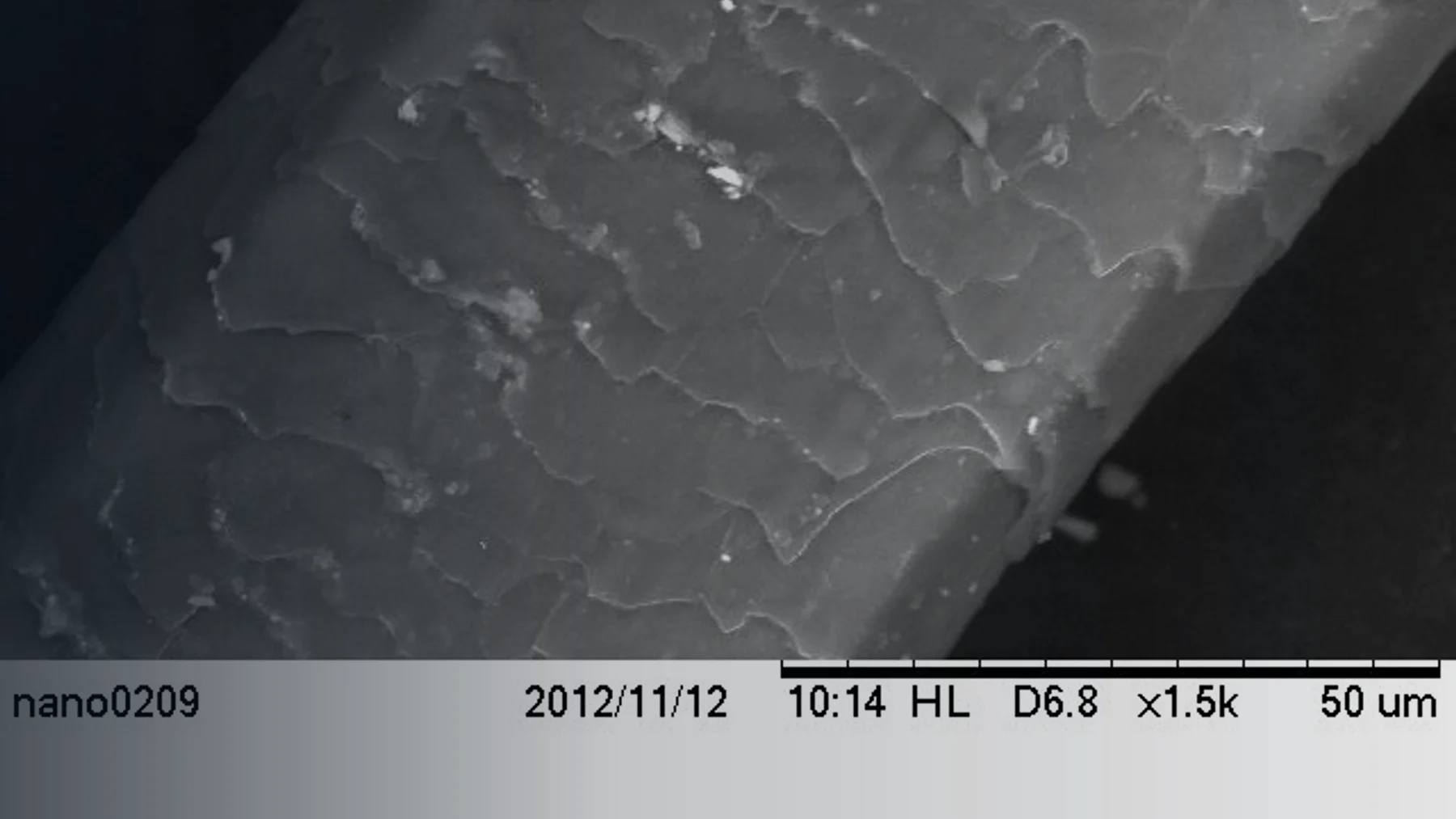
Asian hair · The unverified premise

Asian hair, measured:
shaft thickness and density.

Asian scalp hair averages a shaft cross-section about a quarter larger than Caucasian hair (4,804 against 3,857 µm²) while growing at roughly a quarter lower density, 175 against 226 hairs per cm². Its cross-section is the most circular of the three major hair types. Those are measured figures from the peer-reviewed literature, not a marketing claim, and they cut in opposite directions: more coverage per graft, fewer grafts to take. What they change is tooling and planning: punch diameter against shaft diameter, packing density against blood supply. What they do not tell you is whether the result is better. A protocol tuned on one hair type has to be re-tuned, not transferred; that is the whole of the claim.


The measured differences

Four measurements, from two cited papers.

Means and standard deviations as published. Nothing here is our own measurement, and nothing here is about outcomes.

1 · Shaft cross-section, drawn to scale Every shape encloses its published area at one shared scale. Shape is illustrative; area is exact.
Asian4,804 ± 159 µm²Most circular of the three
Caucasian3,857 ± 132 µm²Oval
African4,274 ± 215 µm²Most flattened
2 · Hairs per cm², at the same scale One dot is one hair, one box is 1 cm². Dot count is the published mean; dot size carries the shaft-width ratio from figure 1.
Asian175 ± 54 hairs/cm²
Caucasian226 ± 73 hairs/cm²

Read the first figure carefully, because the obvious reading of it is wrong. The area difference between Asian and Caucasian shafts is about 25%, and that is the number worth knowing for punch selection. But area grows with the square of width, so the diameter difference is only about 12%, which is what you would actually see down a microscope, and why the drawing looks less dramatic than the percentage sounds. Any diagram that makes Asian hair look half again as wide has drawn the area figure as though it were a width.

And read the second figure with its error bars in mind. The means are 175 against 226 hairs per cm², but the published standard deviations are ±54 and ±73, roughly a third of each mean, and they overlap heavily. So the population averages differ while a particular Asian scalp may well be denser than a particular Caucasian one. That is not a hedge; it is the reason a plan is drawn from your measured donor density rather than from your ethnicity, and the reason nobody should quote you a graft ceiling before measuring.

Metric Asian Caucasian African
Shaft cross-sectional area 4,804 ± 159 µm² 3,857 ± 132 µm² 4,274 ± 215 µm²
Hair density 175 ± 54 /cm² 226 ± 73 /cm² 161 ± 50 /cm²
Growth rate 411 ± 53 µm/day 367 ± 56 µm/day 280 ± 50 µm/day
Donor follicular-unit density 61–63 FU/cm² 65–85 FU/cm² Lowest of the three

Rows one to three: Leerunyakul K, Suchonwanit P. Asian Hair: A Review of Structures, Properties, and Distinctive Disorders. Clin Cosmet Investig Dermatol. 2020;13:309–318 (Table 1), https://pmc.ncbi.nlm.nih.gov/articles/PMC7187942/. Row four: Keene SA, Rassman WR, Harris JA. Determining safe excision limits in FUE. Hair Transplant Forum Int. 2018;28(1):1–11, https://www.ishrs-htforum.org/content/28/1/1.2. Read 2026-07-28.

What changes

What the figures change: tooling and planning.

Punch diameter is chosen against shaft diameter, not applied as a single default; a larger mean cross-section is the reason that choice cannot be inherited from a protocol calibrated elsewhere. Packing density, how close together grafts can sit without starving each other of blood supply, is planned against the donor supply actually available, and the fourth row above is the constraint that matters most: at 61–63 follicular units per cm² against 65–85, there is measurably less to harvest. None of these are new techniques; they are the same FUE and DHI methods described on the procedures pages, planned with different inputs. What that donor constraint means in practice is set out on donor capacity.

A claim we took down

A removed claim: the exit-angle sentence.

It no longer does. That the hair leaves an Asian scalp at a steeper angle is asserted widely (including, until recently, by us), but when we went looking for it in the literature, the peer-reviewed review above turns out to quantify shaft dimensions, density and growth rate and to say nothing about emergence angle, follicle depth or total scalp hair count. Every source we could find for the angle claim was a clinic marketing page citing no one. So we removed it rather than keep repeating it. If we find a primary source, it comes back with the citation attached. We are noting the removal here instead of quietly deleting it because a site that argues you should demand sources has to show what happens when its own turn out not to exist.

What we have not verified

On outcome claims: none are made on this site.

The differences in shaft cross-section, density and donor supply are documented in the literature, and cited above. Whether re-tuning a protocol around them produces a measurably different outcome for the patient is a separate claim, and we have not checked it against a clinical literature review or partner-clinic case data. Until we have, this page will not say our results are better for Asian hair, and it will not say a clinic built on European hair cannot treat Asian hair. Neither claim is something we can currently support, and asserting either would be exactly the kind of unverified promise this site exists to argue against.

Once that verification is done, the plan is to show partner-clinic case volume for Asian hair as a count, not a testimonial, which Korean law forbids us from publishing regardless. Until then, there is no count on this page to show.

Where this leaves you

At consultation, ask about the plan.

If a clinic tells you their Asian-hair results are better without showing you how they measured that, ask the same question we are asking ourselves here. What you can verify today is who performs the extraction (see who holds the punch) and what happens if grafts fail (see the revision terms), both settled in writing before you travel, regardless of how the hair-type question eventually resolves.

FAQ

Common questions about Asian hair.

Does Asian hair need a different punch size?
A thicker average shaft diameter is one of the reasons punch diameter is chosen per patient rather than fixed: the published mean cross-sectional area is about 25% greater than for Caucasian hair. See /procedures/fue/ for how punch selection works.
Is thicker hair an advantage?
It cuts both ways, which is why we present both numbers. A thicker shaft covers more scalp per graft. But Asian scalps also carry fewer hairs per square centimetre and a lower donor follicular-unit density, so there is less to harvest. Neither figure tells you anything about how well grafts take.
Is Korea’s outcome better for Asian hair than a clinic built on European hair?
We do not claim that, and we have not checked it. What we can say is that the tooling and planning differ. See the section above on what changes and what we have not verified.
Can a Turkish clinic treat Asian hair?
Yes. Nothing about Asian hair morphology makes the procedure impossible elsewhere. The question this page answers is whether the protocol is tuned for it, not whether it can be attempted at all.