The number that matters
The limiting number: what is left behind.
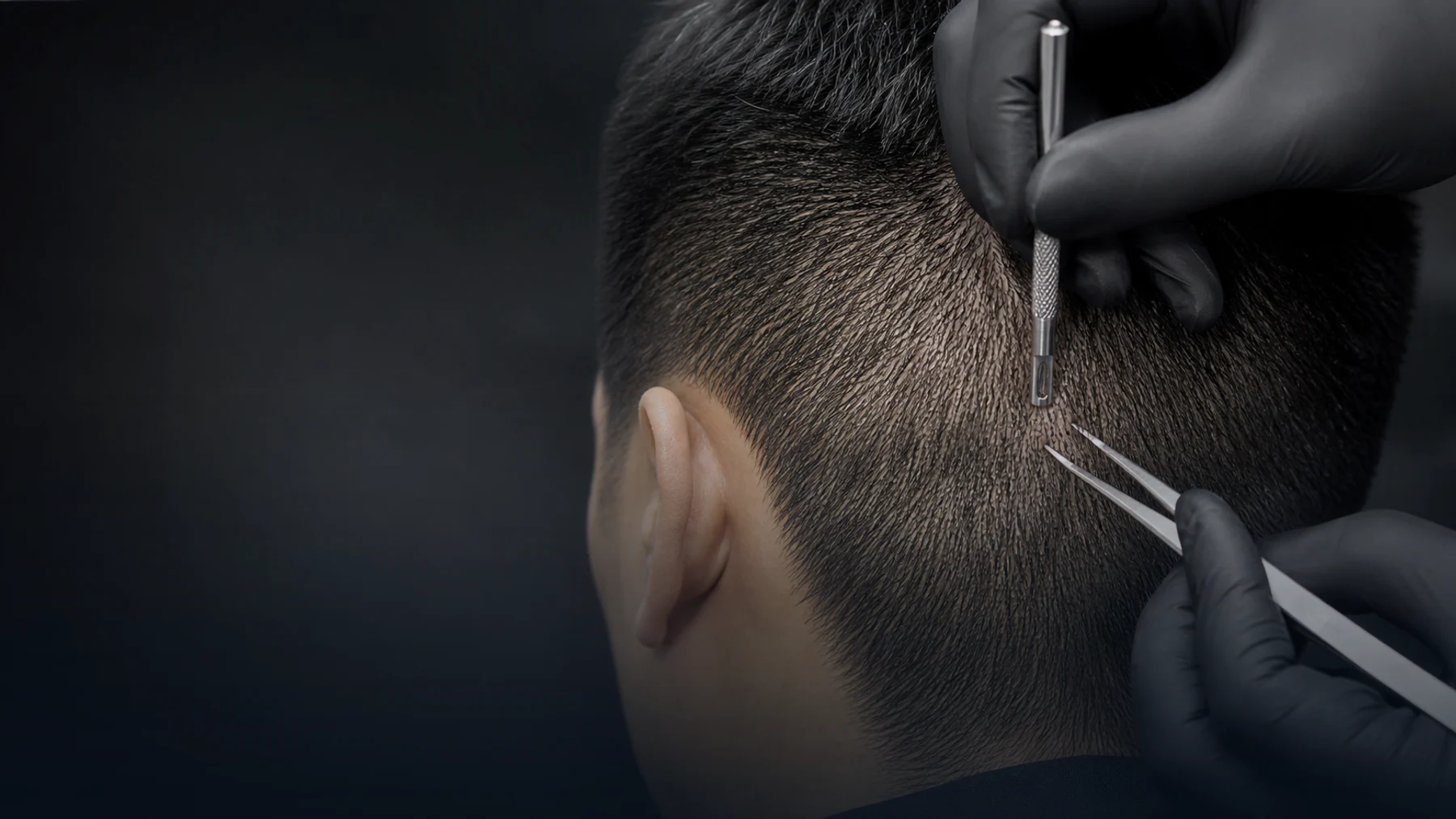
The published safe density for a single FUE pass is roughly 10 to 15 excisions per cm² where baseline donor density is a typical 65 to 75 follicular units per cm², rising to 20 to 25 only where the baseline is well above average. The binding figure sits on the other side of the subtraction: leave 40 to 50 FU/cm² behind, or the donor area stops reading as hair and starts reading as thinning, a result that is permanent and considerably harder to hide than the loss being treated.
This is where the Asian-hair question actually bites, and it bites against us rather than for us. Asian donor scalp carries a baseline of about 61 to 63 FU/cm², below the 65 to 85 typical of Caucasian donor scalp. Same safe fraction, same residual floor, lower starting point: the budget is smaller. A protocol calibrated on European donor density that is applied unchanged will over-harvest, and the failure shows up not in the transplanted area but in the back of the head, months later. The donor capacity page works the arithmetic through.
So the useful consultation question is not "do you do FUE" but "what excision density are you planning, and what residual density will I have". A clinic that has an answer has done the sum. A clinic that answers in grafts rather than in density per cm² has answered a different question.
Keene SA, Rassman WR, Harris JA. Determining safe excision limits in FUE: factors that affect, and a simple way to maintain, aesthetic donor density. Hair Transplant Forum International. 2018;28(1):1–11 (safe single-pass excision density, residual-density floor, and baseline donor density by population) (https://www.ishrs-htforum.org/content/28/1/1.2), measured 2026-07-28.
Punch and shaft
Tooling follows hair characteristics.
Punch diameter is chosen against shaft diameter. Too small and the punch transects the follicle it is meant to free; too large and it takes more surrounding tissue than it needs to, which is what turns a donor area into a field of visible dots. Asian hair averages a shaft cross-sectional area of about 4,804 µm² against about 3,857 µm² for Caucasian hair (roughly a quarter larger), which is a straightforward reason a punch size settled on one population is a starting point rather than a setting for another.
None of this is exotic or proprietary, and no clinic anywhere is prevented from doing it. It is the same FUE described on every clinic's site, with the tool sized to the patient in front of them. What differs is whether the sizing is done deliberately, and whether the person doing it is the person you were quoted by, which is the subject of who holds the punch, and is a question about staffing law rather than about technique.
Leerunyakul K, Suchonwanit P. Asian Hair: A Review of Structures, Properties, and Distinctive Disorders. Clinical, Cosmetic and Investigational Dermatology. 2020;13:309–318, Table 1, doi:10.2147/CCID.S247390, PMID 32425573 (https://pmc.ncbi.nlm.nih.gov/articles/PMC7187942/), measured 2026-07-28.
FAQ
Common questions about this procedure.
- Is FUE the same everywhere?
- The extraction method is broadly standard. What varies is the excision density planned per cm², the residual density left behind, the punch sizing, and who is legally permitted to hold the punch. See /guides/who-holds-the-punch/.
- How does FUE differ from DHI?
- DHI loads each graft into a pen-like implanter for direct placement; conventional FUE uses pre-made recipient-site incisions. The extraction step is the same. See /procedures/dhi/.
- Does coarse Asian hair make FUE easier?
- It cuts both ways. A larger shaft cross-section means more coverage per graft, but Asian donor scalp also carries a lower baseline follicular-unit density (about 61–63 against 65–85 FU/cm²), so there is less to harvest. Neither figure says anything about how well grafts take, and this site makes no claim about that.