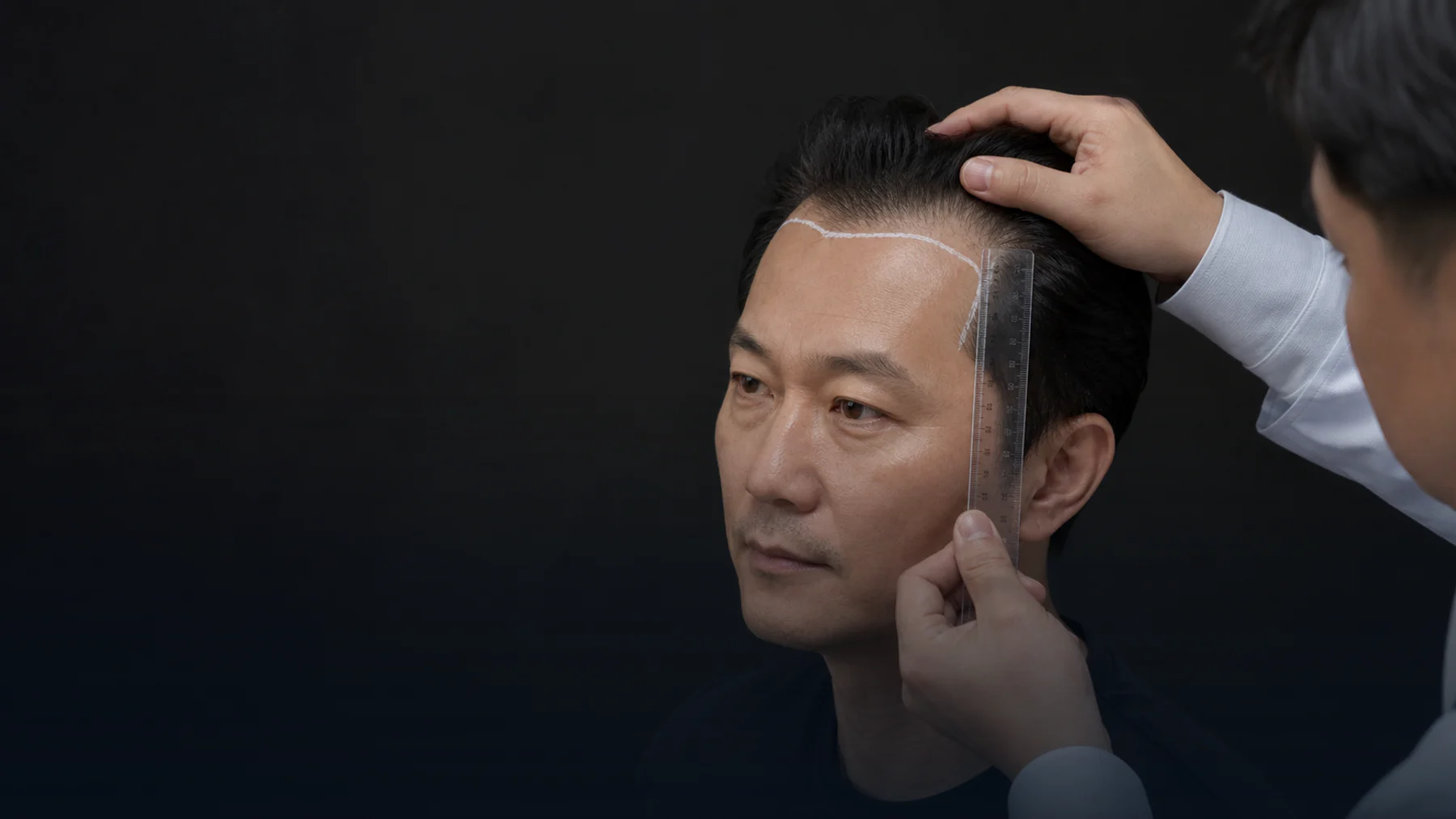
What makes a hairline look built
A straight line and a uniform density.
Two errors account for most obviously transplanted hairlines, and both are design errors rather than surgical ones. The first is regularity: a natural hairline is not a line at all but an irregular transition zone, with stray follicles ahead of the main front and small variations along it. A smooth arc is the single strongest tell, and it happens because a smooth arc is easier to plan and quicker to execute.
The second is uniform density. A natural front fades in (sparse at the leading edge, denser behind it) because the leading edge is mostly single-hair follicular units while the zone behind carries units of two, three or four hairs. Placing multi-hair grafts at the very front produces visible tufting: small clumps emerging from one point where nature would have put one hair. This is why the grafts-versus-hairs distinction on that guide is a planning fact and not just a pricing curiosity. A plan quoted only as a total number of grafts has not described how they are sorted, which is half of the design.
Asian hair raises the stakes on both counts. A shaft cross-section averaging about 4,804 µm² against 3,857 µm² for Caucasian hair means each individual hair is more visible against the scalp, so a tuft that would read as slightly dense in finer hair reads as a plug in coarser hair. The coarser the shaft, the less a design error forgives.
Leerunyakul K, Suchonwanit P. Asian Hair: A Review of Structures, Properties, and Distinctive Disorders. Clinical, Cosmetic and Investigational Dermatology. 2020;13:309–318, Table 1 (shaft cross-sectional area 4,804 ± 159 µm² Asian against 3,857 ± 132 µm² Caucasian), PMID 32425573 (https://pmc.ncbi.nlm.nih.gov/articles/PMC7187942/), measured 2026-07-28.
Where to place it
The target hairline is age-appropriate.
The most consequential decision is how low to go, and the pressure runs one way: patients want the hairline they remember, and a lower line is easy to sell. It is also close to irreversible. Grafts placed at an aggressive height consume donor supply that cannot be recovered, and they commit you to defending that line for the rest of a progressive condition, because loss continues behind a transplanted hairline, and a low front with thinning behind it is a worse outcome than a modest front with a plan.
A conservative line placed with reserved donor supply can always be brought forward later, provided the supply was actually reserved. The reverse operation does not exist in any useful sense. So the question to put to a surgeon is not just where the line will sit but what the plan is if you continue to Norwood V or VI; if the answer does not include a reserved graft budget, the design has been drawn for today's photograph rather than for your scalp.
Density at the front is bounded too. Implantation density of 50 to 70 follicular units per cm² is among the identified risk factors for recipient-site effluvium, so maximising frontal density can shed the native hair immediately behind the new line. The trade-off is real and belongs in the consultation rather than in an aftercare leaflet.
Romera de Blas C, Vega Díez D, Ricart Vayá JM, Gómez Zubiaur A. Complications in follicular unit excision hair transplantation. Frontiers in Medicine. 2026;13:1750989 (implantation density of 50–70 FU/cm² among risk factors for recipient-site effluvium) (https://www.frontiersin.org/journals/medicine/articles/10.3389/fmed.2026.1750989/full), measured 2026-07-28.
FAQ
Common questions about this procedure.
- What makes a hairline look transplanted?
- Two design errors, not surgical ones: a hairline that is too regular, where a natural front is an irregular transition zone rather than a smooth arc; and uniform density, where a natural front fades in because its leading edge is single-hair follicular units and the zone behind uses two- and three-hair units. Multi-hair grafts placed at the very front produce visible tufting.
- How low should my new hairline be?
- Lower is easier to sell and close to irreversible. Grafts placed at an aggressive height cannot be recovered, and pattern loss continues behind a transplanted line, so a low front with thinning behind it is a worse result than a conservative front with reserved donor supply. Ask what the plan is if you progress to Norwood V or VI.
- Who decides the hairline shape?
- The operating surgeon proposes a shape based on your face, your donor supply and your likely progression, and it is agreed with you before the session. In Korea the person who designs it is also the person legally required to perform the incisions. See /surgeons/ and /guides/who-holds-the-punch/.
- Can the hairline be adjusted later?
- It can be brought forward or thickened in a later session, provided donor supply was reserved for that. Moving a hairline backwards is not a meaningful option, which is why the initial height decision carries most of the risk.