Why the crown costs more
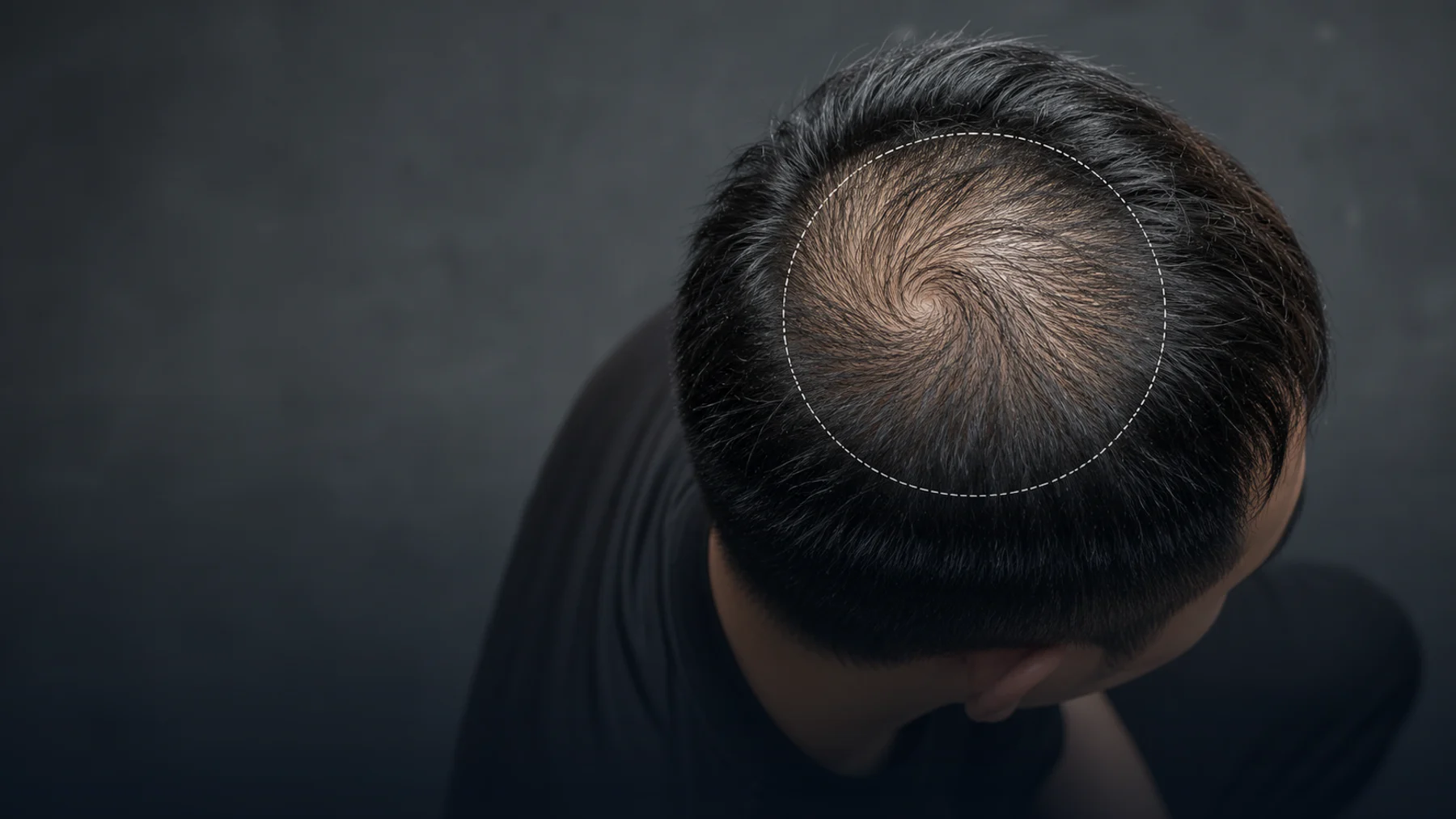
A whorl has no single direction to follow.
In the frontal zone almost every follicle points broadly forward, so a surgeon sets an angle once and works with it. At the vertex the hair spirals out from a centre point, which means the correct angle rotates continuously across the field and every recipient site has to be judged against its neighbours. That is slower work and less forgiving: an angle error in a whorl reads as a cowlick or a flat patch under overhead light, where the same error at the hairline would be invisible.
The crown also sits on a curved surface viewed from above, which is the least flattering angle there is. Scalp shows through a given density more readily on a convex surface than on the near-vertical frontal plane, so an equivalent visual result needs more grafts per square centimetre, and the area is often larger to begin with. That combination is why crown cases consume donor supply quickly.
There is a limit on how far density can be pushed to compensate. High implantation density (50 to 70 follicular units per cm²) is among the identified risk factors for recipient-site effluvium, the temporary shedding described on the shock loss page. Packing the crown hard to fight the viewing angle raises the chance of shedding the native hair still growing around it, which is precisely the opposite of the intended effect.
Romera de Blas C, Vega Díez D, Ricart Vayá JM, Gómez Zubiaur A. Complications in follicular unit excision hair transplantation. Frontiers in Medicine. 2026;13:1750989 (implantation density of 50–70 FU/cm² identified among risk factors for recipient-site effluvium); Norwood OT, Southern Medical Journal 1975;68(11):1359–65 for the vertex as a distinct classification axis (https://www.frontiersin.org/journals/medicine/articles/10.3389/fmed.2026.1750989/full), measured 2026-07-28.
The reservation problem
Crown-first treatment affects later hairline options.
Donor supply is a lifetime budget, not a per-session one, and pattern loss is progressive. Grafts spent on a crown in your thirties are unavailable for a hairline in your forties, and the crown is the area most likely to keep expanding around whatever was placed, because the classification treats vertex progression as its own axis. Treat it early and aggressively and you can end up with a transplanted patch ringed by newer loss, having also spent the supply that would have addressed the front.
This is why an honest crown plan usually looks conservative. It reserves donor supply explicitly for loss that has not happened yet, it accepts a lower density than the frontal zone would get, and it sometimes concludes that the right answer today is medical management with the question revisited in two years. A clinic offering to fill the crown to maximum density in one session, without discussing what remains for the hairline, is describing a sale rather than a plan.
One piece of anatomy worth raising in that conversation: the parietal whorl is not only where the crown pattern radiates from, it is also the landmark a study of 952 Korean men used to locate the permanent safe donor boundary. Loss mostly progresses within 6 cm of the whorl toward the occiput. The same feature that shapes the recipient area partly determines how much donor area exists to spend on it. See donor capacity.
Park JH, Na YC, Moh JS, Lee SY, You SH. Predicting the Permanent Safe Donor Area for Hair Transplantation in Koreans with Male Pattern Baldness according to the Position of the Parietal Whorl. Archives of Plastic Surgery. 2014;41(3):277–284, PMID 24883280 (952 Korean men) (https://pmc.ncbi.nlm.nih.gov/articles/PMC4037775/), measured 2026-07-28.
FAQ
Common questions about this procedure.
- Should the crown or the hairline be treated first?
- Most plans prioritise the hairline: it frames the face, needs fewer grafts for the same visual gain, and is less likely to keep expanding around the treated area. The crown is a separate axis in the Norwood classification and progresses on its own timetable, so treating it first risks spending donor supply on an area that will keep enlarging. It remains a case-by-case surgeon decision.
- Does the crown need more grafts than the hairline?
- Usually yes. The whorl is viewed from above on a convex surface, where scalp shows through a given density more readily than on the frontal plane, and the area is often larger. See /guides/how-many-grafts/ for how the count is actually derived.
- Can the crown be filled to maximum density?
- It should not be. Implantation density of 50–70 follicular units per cm² is among the identified risk factors for recipient-site effluvium, so packing the crown hard raises the chance of shedding the native hair still growing around it.