What it costs, and why
Fewer grafts, dearer each.
The published numbers are unusually clear here because facial work is often listed separately on tariffs. One Tokyo specialist clinic charges a ¥220,000 surgery fee plus ¥1,100 per graft for beard, sideburn and eyebrow cases, against ¥990 per graft for scalp work, about 11% more per graft. Istanbul rates run the other way in absolute terms but the same way in structure: roughly $1,500–3,000 for a moustache at 500–1,000 grafts, and $2,000–3,500 for a partial beard fill at 1,000–2,000 grafts.
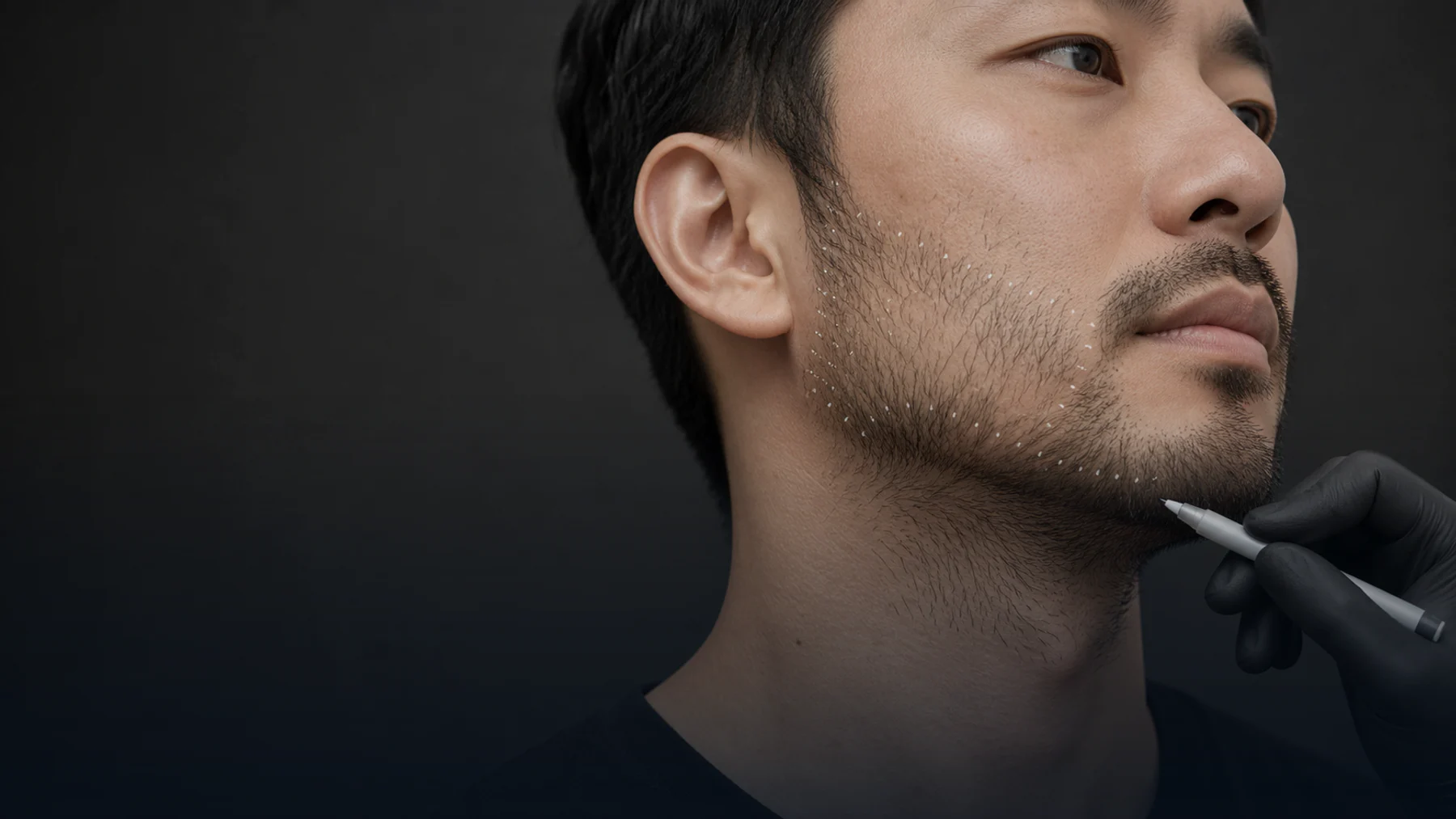
The premium is placement time. Facial hair is mostly single-hair, emerges at a much shallower angle than scalp hair, and changes direction across the jaw, chin and cheek. Each graft therefore has to be selected as well as sited: a surgeon working a beard is picking single-hair follicular units out of the donor harvest and discarding the multi-hair units that would produce visible tufts. Sorting is slow, and the useful fraction of any given harvest is lower.
The absolute cost is still low relative to a scalp case simply because the counts are low. What that hides is the donor cost, which is not low at all in proportion to the result, and that is the part of the trade nobody prices.
NHT Japan (Kioicho Clinic, Tokyo) published tariff: ¥220,000 surgery fee plus ¥1,100/graft for eyebrow, sideburn and beard against ¥990/graft for scalp FUE; Dr. Serkan Aygin Clinic (Istanbul) published pricing: moustache 500–1,000 grafts at $1,500–3,000, partial beard fill 1,000–2,000 grafts at $2,000–3,500 (https://www.nhtjapan.com/price/), measured 2026-07-28.
The donor question
Beard grafts draw on the same donor supply.
Scalp donor supply is a single lifetime budget shared across every procedure you will ever have. A 1,500-graft beard case is 1,500 grafts that are not available for a hairline later, and pattern loss is progressive while a patchy beard generally is not. That asymmetry deserves stating plainly: the beard will not get worse on its own, and the hairline probably will.
The arithmetic behind that budget is on the donor capacity page: safe single-pass extraction of roughly 10 to 15 follicular units per cm², with 40 to 50 FU/cm² left behind, against an Asian baseline donor density of 61 to 63 FU/cm². For most people a beard case is affordable within that budget. For someone already at Norwood IV with average donor density, it may not be, and a clinic that has not run the numbers before quoting is quoting on the wrong constraint.
The transplanted hair also keeps the growth habit of its scalp origin, which means it grows at scalp speed and to scalp length rather than settling at beard length. It needs regular trimming, permanently. That is not a complication, but it is a maintenance commitment nobody mentions at consultation.
Keene SA, Rassman WR, Harris JA. Determining safe excision limits in FUE. Hair Transplant Forum International. 2018;28(1):1–11 (safe single-pass excision density, residual-density floor, and Asian baseline donor density of 61–63 FU/cm²) (https://www.ishrs-htforum.org/content/28/1/1.2), measured 2026-07-28.
FAQ
Common questions about this procedure.
- How much does a beard transplant cost?
- Published rates put a moustache at roughly $1,500–3,000 for 500–1,000 grafts and a partial beard fill at $2,000–3,500 for 1,000–2,000 grafts in Istanbul. A Tokyo clinic charges ¥220,000 plus ¥1,100 per graft for facial work, about 11% more per graft than its ¥990 scalp rate, because placement is slower.
- Will beard-transplanted hair look like facial hair?
- It keeps the texture and growth habit of its scalp origin, which the surgeon accounts for by selecting single-hair follicular units and matching the shallower angle facial hair grows at. It also grows to scalp length rather than beard length, so it needs regular trimming permanently.
- Does a beard transplant use up scalp donor supply?
- Yes, it draws on the same finite lifetime budget as any scalp case. A 1,500-graft beard is 1,500 grafts unavailable for a hairline later, which matters because pattern hair loss is progressive while a patchy beard generally is not. See /guides/donor-capacity/.