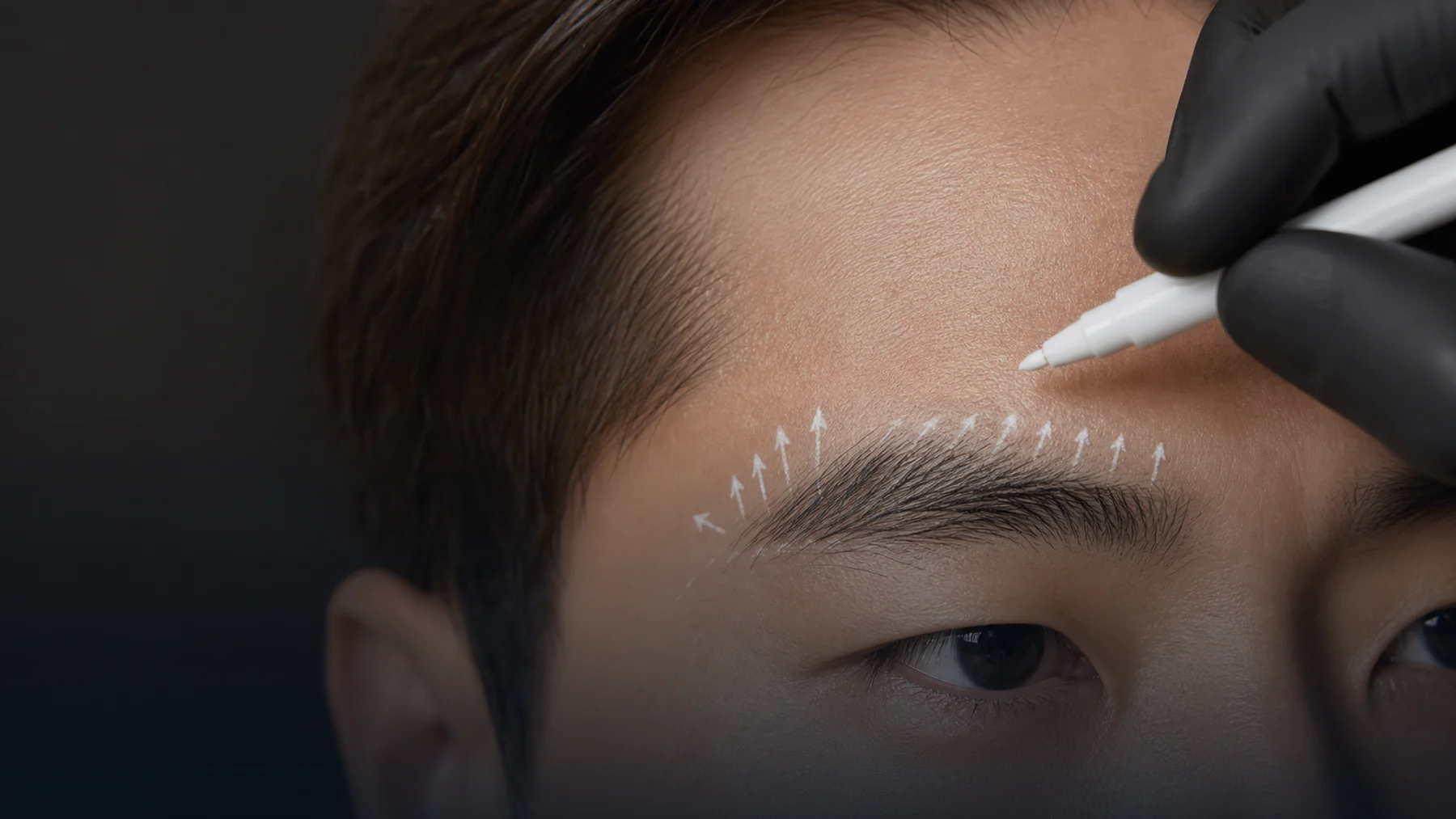
Why angle is the hard part
Brow hair changes direction three times across one eyebrow.
Scalp hair emerges at a moderate angle and runs broadly one way across a zone. Eyebrow hair does neither. It lies almost flat against the skin, and its direction rotates along the brow: sweeping upward at the head of the brow, flattening to horizontal through the body, and angling downward toward the tail, with the upper and lower rows often pointing slightly toward each other. Reproducing that means the angle and direction are decided per graft rather than per zone.
Every graft also has to be a single-hair follicular unit. A two-hair unit in an eyebrow produces a visible fork, and given that a follicular unit averages about two hairs, most of a harvest is unusable here: the surgeon is selecting a minority fraction and setting the rest aside. That selection burden, not the count, is what the per-graft premium pays for.
Coarse hair narrows the margin further. Asian scalp hair averages a shaft cross-section of about 4,804 µm² against 3,857 µm² for Caucasian hair, and a thicker shaft placed in a brow is more conspicuous per hair, both in the density it creates and in how visibly a wrong angle reads. The finest available donor hair is generally preferred for this reason, which constrains where on the scalp it can be taken from.
NHT Japan (Kioicho Clinic, Tokyo) published tariff: ¥220,000 surgery fee plus ¥1,100/graft for eyebrow, sideburn and beard against ¥990/graft for scalp FUE; Leerunyakul K, Suchonwanit P, Clinical, Cosmetic and Investigational Dermatology 2020;13:309–318, Table 1, for shaft cross-sectional area by population (https://www.nhtjapan.com/price/), measured 2026-07-28.
What you are signing up for
It grows like scalp hair because it is scalp hair.
Transplanted brow hair keeps the growth characteristics of where it came from. Native eyebrow hair has a short growth phase and stops at brow length by itself; scalp hair does not, so transplanted brows keep growing and require trimming roughly every one to two weeks, permanently. This is the single most common surprise reported after the procedure, and it is entirely predictable. It should be said before the consent form, not after.
The recovery follows the same published pattern as any FUE case: crusting appears within 2 to 3 days and clears by 7 to 10, shedding runs 2 to 8 weeks, regrowth begins around 3 months, and the result matures at roughly 12 months. On a brow that timeline is more socially exposed than on a scalp, because there is nothing to comb over it. See the recovery timeline.
One thing worth weighing before booking: unlike a hairline, an eyebrow has a well-developed non-surgical alternative in microblading, which is reversible in the sense that it fades. A transplant does not fade. For a brow thinned by over-plucking that may still recover, the reversible option first is often the better sequence, and a clinic willing to say so is telling you something useful about how it sells.
Romera de Blas C, Vega Díez D, Ricart Vayá JM, Gómez Zubiaur A. Complications in follicular unit excision hair transplantation. Frontiers in Medicine. 2026;13:1750989 (crusting 2–3 days resolving by 7–10 days, recipient-site effluvium 2–8 weeks, regrowth from ~3 months, maturation ~12 months) (https://www.frontiersin.org/journals/medicine/articles/10.3389/fmed.2026.1750989/full), measured 2026-07-28.
FAQ
Common questions about this procedure.
- Will eyebrow-transplanted hair need trimming?
- Yes, permanently: roughly every one to two weeks. It keeps the growth habit of the scalp hair it came from, and scalp hair does not stop at brow length the way native eyebrow hair does.
- How many grafts does an eyebrow transplant use?
- Far fewer than a scalp session, and the count is not what drives the cost. Every graft must be a single-hair follicular unit, so most of a harvest is unusable for brows, and each one is angled and directed individually, which is why a Tokyo tariff charges ¥1,100 per graft for eyebrow work against ¥990 for scalp.
- Is an eyebrow transplant better than microblading?
- They are different commitments. Microblading fades; a transplant does not. For a brow thinned by over-plucking that may still recover on its own, the reversible option first is often the better sequence.