What the premium buys
A different instrument, for the same operation.
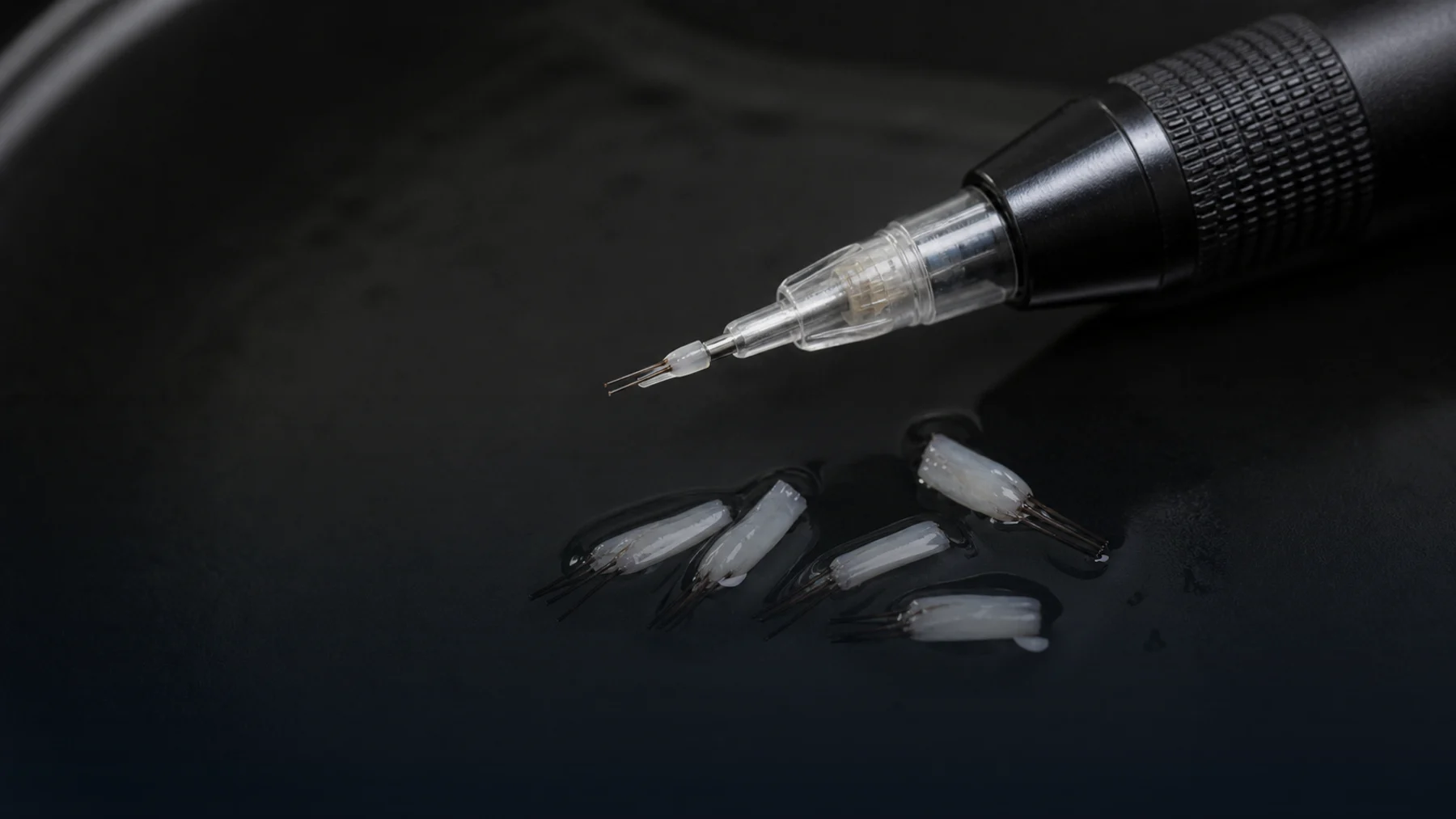
In conventional FUE the recipient sites are cut first, as a set, and grafts are then placed into them. In DHI the implanter pen does both at once: the graft sits loaded in a hollow needle, the needle makes the site, and the graft is pushed in as the needle withdraws. The claimed advantages follow from that. Grafts spend less time outside the body, and angle and depth are set per graft as it goes in rather than per site beforehand.
The claimed advantage that deserves more scepticism is density. DHI is routinely sold as permitting closer packing, and the constraint on packing density is not really the instrument. It is blood supply: grafts placed too close together compete for perfusion, and that ceiling applies whichever way the site was made. An implanter can make placement at a given density more controlled. It does not raise the density at which the tissue can support what you placed.
The price premium is real and consistently signposted, which at least makes the trade-off legible: about 29% at the Istanbul clinic above, and a similar direction of travel elsewhere. It reflects slower per-graft placement and more consumables. Whether that buys you anything depends on the case, and on whether your particular concern is placement control, in which case it might, or final density, in which case the biology is the binding constraint rather than the pen.
Cosmedica (Istanbul) published package pricing: Micro Sapphire DHI €3,290 against FUE Sapphire €2,550, both quoted to the same 4,000-graft ceiling (https://cosmedica.com/price/), measured 2026-07-28.
Choosing between them
What it changes for your case.
Neither technique is categorically better and any clinic saying otherwise is selling one of them. DHI tends to be proposed for smaller, precision-heavy work: a hairline, an eyebrow, filling between existing hairs where pre-cutting sites is awkward. Conventional FUE tends to be proposed for larger sessions, where the pre-made-site workflow is faster and session length is itself a clinical variable.
A useful test at consultation: ask what specifically changes for your case, and whether the answer is about placement control or about final density. The first is a reasonable argument. The second usually is not, for the perfusion reason above. And if the answer is about graft survival, note that this site publishes no survival figure for any technique, not because the comparison is uninteresting, but because we could not source one, which is also worth knowing about anybody who quotes you one.
FAQ
Common questions about this procedure.
- Is DHI better than FUE?
- Neither is categorically better. They differ in workflow and instrument; the extraction step is identical. DHI is more often proposed for precision work and conventional FUE for larger sessions.
- Does DHI cost more?
- Yes. At one Istanbul clinic the DHI package is €3,290 against €2,550 for sapphire FUE at the same graft ceiling, roughly 29% more, reflecting slower per-graft placement and more consumables.
- Does DHI allow higher density?
- It allows more controlled placement at a given density. The ceiling on density itself is blood supply to the recipient area, which does not change with the instrument used to make the site.